Truckload Capacity Is Tightening — A Closer Look at the Data Behind the Shift
The U.S. trucking industry has entered a driver shortage for the first time in four years. Unlike prior shortage cycles, which were typically attributed to driver demographics, turnover, or a sudden demand spike, this one is primarily regulatory in origin — and that distinction matters for how shippers should respond to it.
Background: What Changed
In recent months, the Federal Motor Carrier Safety Administration (FMCSA) has tightened eligibility requirements for non-domiciled commercial driver's licenses and moved to remove a substantial number of CDL training providers from the federal Training Provider Registry. Estimates suggest the non-domiciled CDL rule alone could affect roughly 200,000 drivers — approximately 5% of all active interstate CDL holders nationally.
It's worth noting that this rule has had a contested legal history: an earlier version was placed under a court stay in late 2025. However, industry analysts have observed that practical capacity constraints have remained in effect in many states regardless of the rule's precise legal status, as carriers and drivers have adjusted operations in anticipation of enforcement.
Where the Impact Is Concentrated
A national average of "5% of drivers" can understate the real effect, because this change is not distributed evenly across the market. Non-domiciled drivers are disproportionately represented in drayage and port-adjacent trucking in certain regions. Texas, for example, has been flagged as particularly exposed — it handles more freight tonnage than any other state, has a sizable immigrant driver population directly affected by the rule, and is simultaneously facing elevated freight demand from data center, energy, and construction activity. In corridors like this, the effective capacity reduction is considerably more acute than the national average implies.
What the Rate and Capacity Data Shows
Several independent data sources are now converging on the same conclusion:
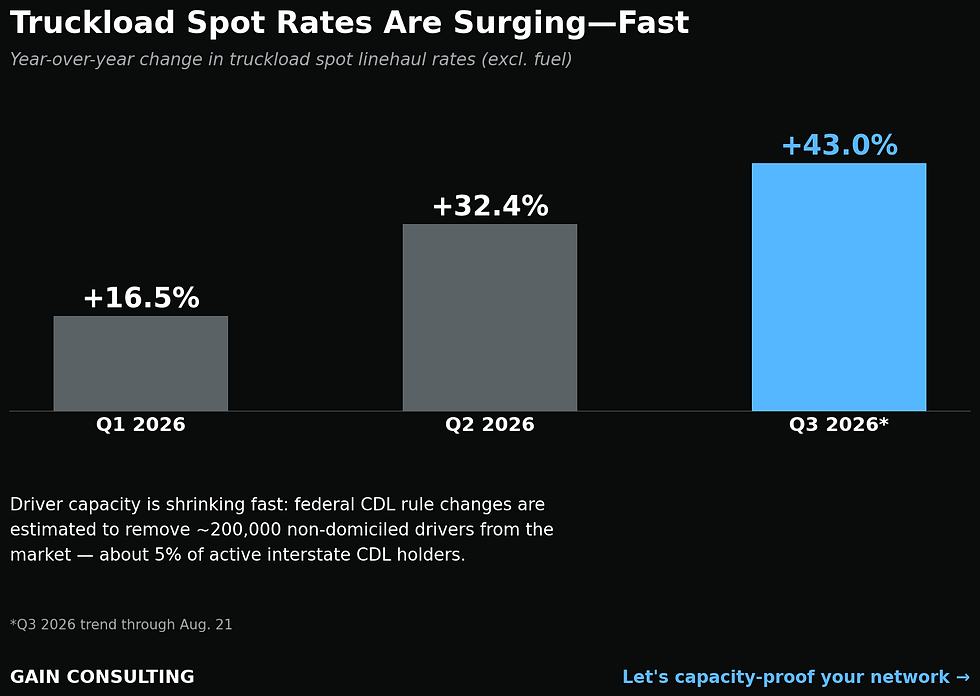
Spot rates: According to RXO's Curve forecast, year-over-year truckload spot linehaul rates (excluding fuel) rose 16.5% in Q1 2026, accelerated to 32.4% in Q2 2026, and were tracking at approximately 43% year-over-year through late August in Q3 2026.
Driver availability: ACT Research's Driver Availability Index fell to 30.4 in April 2026 — a five-year low — immediately following the non-domiciled rule taking effect in mid-March. It has since posted a partial recovery to 34.1 in June, but remains well below pre-shortage levels.
Capacity index: ACT Research's Capacity Index for For-Hire Trucking climbed to 55.0 in June, a 43-month high — notable because this gain is occurring even as Class 8 tractor sales continue to run below fleet replacement levels, suggesting the tightening is structural rather than a temporary seasonal effect.
Taken together, these indicators describe a market where capacity is leaving faster than new capacity (via equipment or drivers) is entering it.
Why This Matters More Than the Headline Percentage Suggests
It is worth being precise about what the rate data represents. The figures above describe spot market rates, which typically move well ahead of contract rates. Shippers currently operating under contracts negotiated a year or more ago may not yet see this reflected on their invoices. Historically, spot rate movements of this magnitude tend to surface in contract pricing within two to four quarters, meaning the shippers least aware of this shift today may be the ones most exposed at their next bid or renewal cycle.
There is also a meaningful difference between aggregate capacity and usable capacity for a given shipper. Carriers most affected by the non-domiciled rule tend to pull back first on spot capacity, ad hoc coverage, and marginal or lower-margin lanes — not necessarily their core, contracted freight. For a shipper whose network depends on occasional spot coverage to handle volume spikes, seasonal surges, or lane imbalances, this is precisely where capacity is becoming hardest to secure, even if their primary lanes still appear stable on paper.
What We're Seeing Among Current Clients
Gain Consulting is currently working with clients to get ahead of this shift rather than wait for it to surface at renewal. That work generally falls into three categories:
Carrier mix diversification — reducing single-carrier dependency on lanes historically covered by one or two core providers, particularly where those carriers have known exposure to non-domiciled driver populations.
Mode flexibility review — reassessing whether lanes that have traditionally run exclusively truckload have viable intermodal or LTL alternatives that reduce exposure to truckload-specific capacity pressure.
Proactive rate benchmarking — initiating rate reviews ahead of the renewal calendar, rather than discovering the market has moved during a bid event with limited lead time to respond.
The Open Question for Shippers
Analysts remain divided on how long this cycle will last. Some project the capacity constraint as a multi-year structural shift as attrition compounds; others note the regulatory and legal landscape remains unsettled and could shift again. What is not in dispute is that the rate and capacity data for the first three quarters of 2026 already reflects a meaningfully tighter market than the one most shippers built their current contracts around.
The relevant question for any shipper is not whether the market has changed — the data confirms it has — but whether their network strategy, carrier mix, and contract terms have been revisited to reflect that change.
We welcome a conversation with any shipper looking to assess their specific exposure to this shift.


Comments