August LMI : Logistics Costs Keep Climbing, Even as Capacity Loosens
The August Logistics Managers' Index (LMI) landed at 66.6, down 2.2 points from July and 4.4 points off June's four-year peak of 71.1. On paper, that's a cooling. But the real story in this month's report is that cooling activity isn't translating into cooling costs. Capacity is loosening in both warehousing and transportation, yet prices in both categories are still climbing — in transportation's case, at a rate that's historically rare.
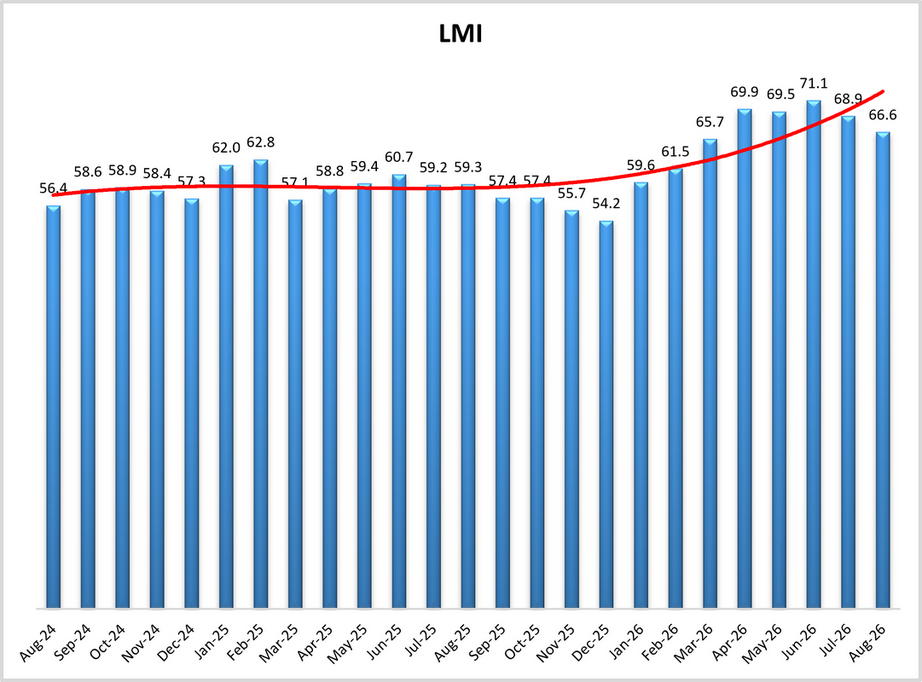
Costs Are Rising No Matter What the Underlying Conditions Are
Inventory levels grew more slowly in August, landing at 52.8 — barely above the break-even mark. Inventory costs, meanwhile, rose to 78.6, which means the cost of carrying inventory is now growing about 25.8 points faster than the volume of inventory itself. That gap is nearly double its historical average, and it has widened considerably since tariffs took effect last year.
Transportation tells a similar story. Capacity is still shrinking, but at a much slower pace than July's near-record low. Even so, the Transportation Prices Index rose 3.1 points to 90.0 — the fourth time in five months it has hit 90 or above, on a scale that tops out at 100. Warehousing followed the same pattern: capacity moved into expansion for the first time since December, yet warehousing prices remained elevated at 75.0.
The LMI's aggregate logistics cost measure has averaged roughly 242 since the Iran conflict began in March — up from around 205 in the stretch between the first tariff wave and the conflict, and well above the pre-tariff average near 194. Readings above 240 have historically coincided with supply-driven inflation.
Fuel Is Still the Wild Card
The report ties much of the transportation price pressure to fuel. U.S. diesel averaged about $5.65 per gallon in the last week of August — up roughly 23.5% from the early-July low — and the report points to multiple overlapping disruptions in global oil supply, including the prolonged closure of the Strait of Hormuz, renewed attacks affecting Red Sea shipping, and reduced Russian refining capacity. (Diesel has since climbed further; we covered the record-setting mid-September prices separately.)
The Squeeze Reaches Consumers and Trade Partners
The cost pressure is showing up downstream. Consumer sentiment fell more than 6% in August, with shoppers citing fuel prices and lingering inflation. Spending patterns are shifting toward lower-priced goods, with dollar retailers reporting sales gains while big-ticket categories soften. The labor market also weakened in July, adding complexity for the Federal Reserve as it weighs inflation against slower hiring.
Trade policy is adding another layer. A proposed 50% tariff on Canadian goods would hit the country's second-largest trading partner, with construction, auto manufacturing, and energy among the most exposed industries — and the report notes the dispute could stretch on through the November midterms.
Warehousing: More Space, But Not Cheaper Space
Warehousing capacity improved to 53.5 in August, driven largely by changes late in the month, and industrial real estate activity is up sharply year over year. But development is still lagging demand, and respondents don't expect added space to bring prices down — warehousing price expectations for the next year actually rose, particularly among upstream firms. Automation is increasingly part of the response, with North American robot orders on pace to match last year's record.
What This Means
Don't assume loosening capacity will bring rates down. The data shows capacity improving in both warehousing and transportation while prices continue to rise. Waiting for relief at the next contract cycle is a risky strategy.
Inventory carrying costs deserve a fresh look. With inventory costs growing far faster than inventory levels, lean-versus-buffer decisions carry real financial weight right now — and retailers appear to be rebuilding stock ahead of Q4 after drawing down over back-to-school.
Upstream and downstream expectations are diverging. Upstream firms expect transportation capacity to keep contracting over the next year, while downstream firms expect slight expansion. Shippers on the upstream side should plan for tighter conditions than their downstream counterparts anticipate.
Cost pressure is hitting everyone, not just small shippers. Larger firms reported faster growth in both warehousing and transportation prices than smaller firms this month — a reversal of last year's pattern, when tariff costs fell harder on smaller companies.
Respondents' 12-month outlook for the overall index is 69.6, signaling continued strong expansion — and, importantly, they expect transportation prices to stay near 86 and warehousing prices to climb further. In other words, the industry itself isn't forecasting relief.
Source: Logistics Managers' Index Report, August 2026, issued by the LMI research team in conjunction with the Council of Supply Chain Management Professionals (CSCMP).


Comments