October 2025 Cass Freight Index: Shipments Plunge 7.8% YoY Amid LTL-to-TL Shift and Tariff Uncertainty
- Kelsea Ansfield
- Nov 13, 2025
- 4 min read
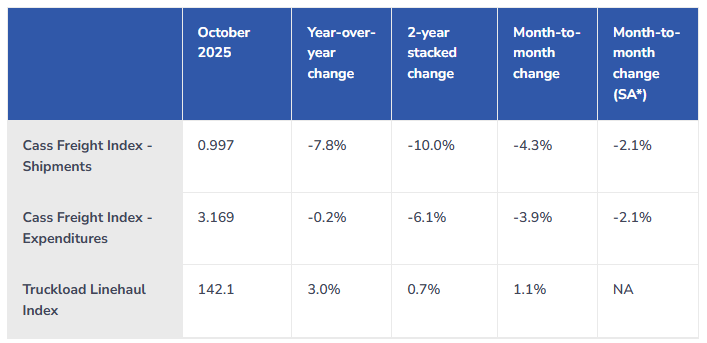
The Cass Freight Index® for October 2025 delivered a sobering snapshot of the freight market: shipments fell 4.3% month-over-month (m/m) (or **2.1% in seasonally adjusted terms), reversing September's gains, while the year-over-year (YoY) decline widened to 7.8% from 5.4%. Expenditures dipped 3.9% m/m and turned flat YoY (-0.2%), implying inferred rates rose 8.2% YoY—largely from shippers consolidating LTL loads into TL to dodge ongoing rate hikes.
At Gain Consulting, we see this as a clear signal of structural strain: demand air pockets persist, driven by LTL insourcing at mega-shippers and tariff-induced caution, but rate resilience hints at a market bottom. With the Supreme Court's IEEPA tariff ruling looming (potentially by June 2026), shippers face escalating inflation risks. This in-depth analysis unpacks the data, forecasts 2025's trajectory, and provides five actionable strategies to safeguard your freight spend amid the uncertainty.
Shipments: A Reversal and Widening Gap
The shipments index—tracking North American freight volumes across truckload (TL), LTL, rail, parcel, and more—captures a market stuck in neutral:
October m/m: -4.3% (raw); -2.1% SA — erasing September's +2.5% SA gain.
October YoY: -7.8% — deepest decline since March 2025's -8.2%.
Trend: After +13% in 2021 and +0.6% in 2022, shipments fell -5.5% in 2023 and -4.1% in 2024. 2025 is on pace for another ~4-5% drop, with November projected at -10% YoY on seasonal patterns.
The contraction is concentrated in LTL, where rate increases in a soft market (up ~10.5% YoY per Cass LTL PPI) are pushing shippers to consolidate into TL or insource via private fleets. Two mega-shippers alone account for much of the shift, per Cass analysis.
Broader Context: This aligns with ATA's September tonnage dip (-0.9% m/m) and U.S. Bank’s Q3 shipments -2.9% QoQ. Tariff front-loading spiked Q3 volumes, but post-hike pauses and consumer caution (sentiment at 53.6) are now biting.
Expenditures: Flat YoY Masks Rate Strength
The expenditures index—total freight spend—offers a more nuanced view:
October m/m: -3.9%; -2.1% SA (mirroring shipments).
October YoY: -0.2% — flipping September's +2.2% gain.
Inferred Rates: +8.2% YoY — unchanged SA m/m, driven by modal mix (more TL, less LTL).
Historical context: After +38% in 2021 and +23% in 2022, expenditures plunged -19% in 2023 and -11% in 2024. 2025 trends toward flat to -2%, with rate hikes offsetting volume weakness.
The Cass Truckload Linehaul Index reinforces this: +1.1% m/m in October (from +1.7% in September); +3.0% YoY (from +2.6%). But early November spot softening suggests the uptick may be pre-tariff fleeting.
The Drivers: LTL Squeeze, Insourcing, and Tariff Clouds
LTL Contraction Accelerates
Rate Pressure: Ongoing hikes (~10.5% YoY) in a volume-down market (-6-9% YoY per Q3 SEC filings) force consolidation.
Mega-Shipper Shift: Two giants insourcing LTL, reducing for-hire reliance by 15-20%.
Gain Insight: TL modal shift saves 5-8% on consolidated loads, but accessorials rise 12%—net neutral without optimization.
Tariff Uncertainty Looms Large
IEEPA Ruling: Supreme Court decision on International Emergency Economic Powers Act tariffs could come soon to June 2026. If upheld, inflation severity escalates; if struck down, relief for importers.
Demand Air Pockets: Front-loading spikes (e.g., Q3 Port of LA +2M TEUs) followed by pauses create capacity whiplash.
2025 Trajectory: Shipments on track for -4-5% decline; expenditures flat. November: -10% YoY shipments.
Freight Expectations: Fleets in Survival Mode
Financial Strain: Generational low margins for public TL fleets; equipment investment curtailed amid tariff-driven cost inflation.
ACT Outlook: 2026 equipment demand declines; rates insufficient to offset costs.
Capacity Dynamics: Highway tractor contraction accelerates—for-hire closures + private fleet reversal.
Regional and Sectoral Nuances
West/Northeast: +4-6% YoY activity from tariff pre-buying and manufacturing rebound.
Southwest/Midwest: -11-33% YoY due to ELP rules, housing slumps.
Sectors: Electronics +6.4%, auto flat, construction -0.3%—LTL hits hardest in retail/consumer goods.
Client Impact: A CPG shipper shifted 25% LTL to TL consolidation, cutting expenditures 7.2% while maintaining 98% OTP—despite October's 7.8% shipment plunge.
2025-2027 Forecast: Cautious Bottoming
Shipments: -4-5% full-year; November -10% YoY.
Expenditures: Flat to -2%; rates +1-2% in 2025, modest rebound in 2026.
Truckload Linehaul: +1.5% 2025 after -3.4% 2024; 2026 tightening from fleet contraction.
Wild Card: IEEPA ruling—uphold = prolonged air pockets; strike = +2-3% volume lift.
ACT Freight Forecast (via Cass): Expects over 40 series tracked monthly, including DAT spot/contract rates, LTL/intermodal PPIs—essential for 2-3 year horizon planning.
Final Word: Navigate the Dip, Seize the Rebound
October's Cass data confirms the freight market's stubborn weakness: 7.8% shipment contraction, flat expenditures, and LTL bleed to TL. But beneath the numbers lies rate floor resilience and insourcing limits—precursors to 2026 tightening.
Don’t wait for the Supreme Court. Model the risks now. Lock the rates today. Diversify the modes tomorrow.
Gain Consulting equips you with Cass-integrated forecasting, modal optimization, and tariff defense to turn uncertainty into edge.
Sources: Cass Freight Index® Report – October 2025; ACT Research Freight Forecast


Comments