August 2026 Logistics Manager’s Index: Costs Keep Rising Even as Capacity Starts to Ease

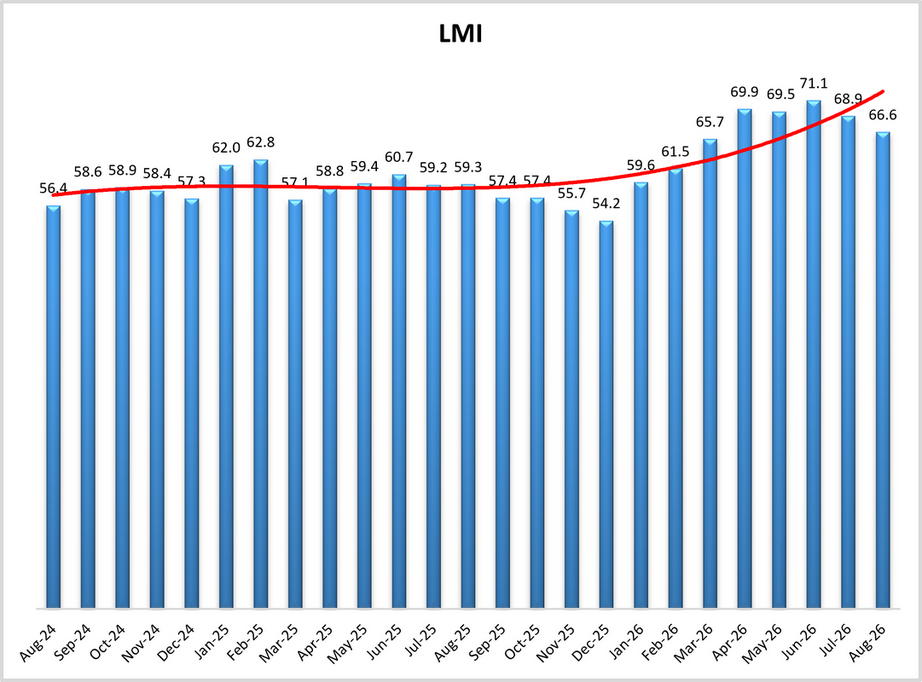
The August Logistics Manager’s Index (LMI) came in at 66.6, down 2.2 points from July’s 68.9 and further below June’s recent four-year high of 71.1. Logistics activity is still expanding, but the pace of growth is slowing. The slowdown is driven primarily by softer inventory levels, while costs across the board continue to climb at a rapid rate.
For shippers and logistics managers, the message is clear: the underlying pressure on transportation, warehousing, and inventory costs remains intense.
Key Takeaways from the August Report
Inventory Levels eased to 52.8 — just barely above the 50.0 expansion threshold. Upstream respondents actually reported mild contraction at 49.0, while Downstream firms showed stronger growth at 61.9. This split suggests retailers may be rebuilding inventories ahead of the fourth quarter after drawing them down during the back-to-school period.
Despite the slowdown in inventory buildup, Inventory Costs accelerated to 78.6, their second-highest reading in the past 12 months. The gap between Inventory Costs and Inventory Levels now stands at 25.8 points — nearly double the historical average. Inventories are becoming more expensive to hold on a relative basis, a trend that has intensified under the current tariff environment.
Warehousing Capacity moved back into expansion territory at 53.5, its strongest reading since December 2025. Additional space is coming online, helped by increased investment in industrial real estate and automation. However, Warehousing Prices remained elevated at 75.0. More capacity has not yet translated into meaningful relief on rates.
Transportation Capacity continued to contract at 40.0, though the rate of contraction slowed significantly from July’s near-record low of 28.4. Meanwhile, Transportation Utilization rose to 70.6 and Transportation Prices jumped to 90.0 — marking the fourth time in the last five months that this metric has registered at or above 90. Freight rates remain under extreme pressure, influenced by elevated diesel prices and ongoing geopolitical disruptions.
In short, the report describes a logistics environment in which costs are rising faster than activity in many categories. Aggregate logistics costs (Inventory Costs + Warehousing Prices + Transportation Prices) remain well above levels seen prior to recent tariff and geopolitical developments.
What This Means for Shippers
High relative inventory holding costs, stubbornly elevated warehousing rates, and transportation prices near the top of the index create a challenging environment heading into peak season. Even as some capacity metrics improve, the cost side of the equation shows little relief.
Shippers that rely solely on volume-based strategies or wait for market conditions to normalize may find margins under continued pressure. Those that actively manage carrier relationships, optimize inventory positioning, and scrutinize accessorial and peak-related charges are better positioned to protect profitability.
How Gain Consulting Can Help
At Gain Consulting, we work with shippers to reduce the effort, time, and cost of managing complex supply chains. In the current environment, that often means:
Auditing freight and accessorial charges against current market conditions and contract terms
Identifying opportunities to shift volume, modes, or timing to mitigate peak and high-cost periods
Reviewing inventory strategies and network design to lower holding and storage costs
Supporting negotiations with carriers and 3PLs as capacity and pricing dynamics evolve
The August LMI underscores that cost inflation in logistics is not purely volume-driven. Capacity is beginning to loosen in some areas, but pricing power remains with providers in others. A disciplined, data-driven approach to cost management remains essential.
If you would like a focused review of how these trends are affecting your network — or an assessment of potential savings opportunities — we are available to discuss. Our team provides a no-cost initial analysis and stands behind our ability to deliver measurable results.
Stay proactive. The data suggests the pressure is not easing quickly.


Comments